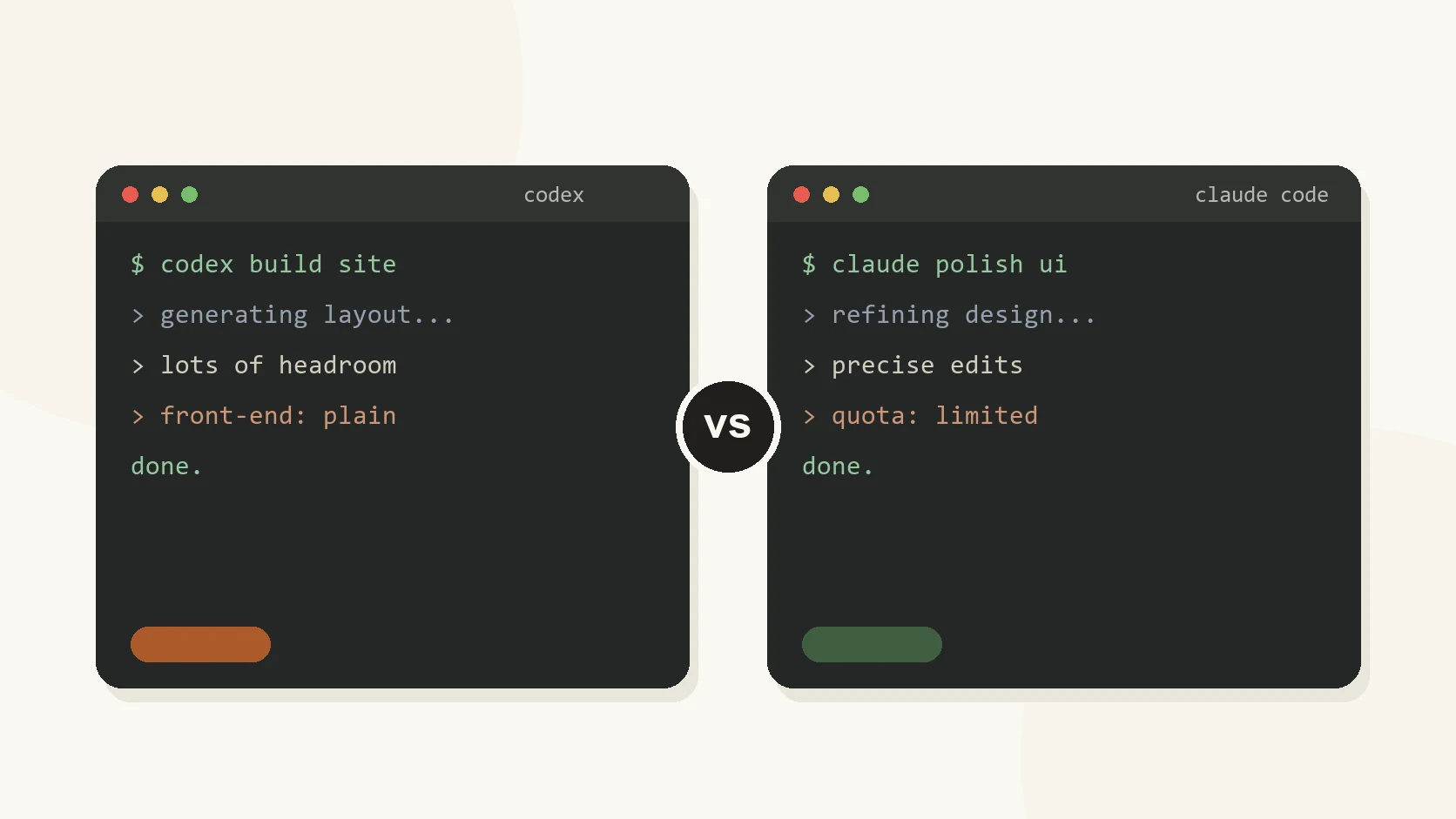
I shipped a real site, so this is not a benchmark tour
Most Codex-versus-Claude-Code write-ups compare scores on coding puzzles. I have a different vantage point: this website was built with Codex, and its ongoing updates run through Claude Code. That means my opinions come from finishing and maintaining an actual project, not from a test harness. It also means my conclusions are about one kind of work, building and looking after a content website, not about every programming task in existence.
I started with Codex because it was already part of the ChatGPT subscription I paid for. Later I added Claude Code for the parts where Codex kept letting me down. Both cost $20 a month, and I now use each for what it does best.
Quick verdict
Reach for Codex when you want to build the bulk of a site and keep going without watching a usage meter. For general construction, it is generous and gets ordinary work done.
Reach for Claude Code when the job needs care: cleaner front-end work, tricky fixes, and changes you want done precisely the first time. The catch is a tighter allowance that runs out faster.
For a standard website, Codex alone is usually enough. If you specifically want the site to look and behave better than "fine," Claude Code is the one I switch to.
At-a-glance comparison
| Criterion | ChatGPT Codex | Claude Code |
|---|---|---|
| Plan I use | ChatGPT Plus, $20/month | Claude Pro, $20/month |
| How I run it | Desktop app | Desktop app |
| Usage headroom | Generous; rarely blocks me | Limited; officially aimed at light use |
| General build work | Handles most of it well | Also strong, but spend it deliberately |
| Front-end polish | Functional but plain | More refined in my experience |
| Getting stuck | Can loop on a fix it cannot land | More likely to resolve it cleanly |
| Relative running cost | Feels cheaper per unit of work | Feels more expensive to keep running |
| Best role for me | Build the site | Polish and maintain the site |
The plan rows come from official documentation. Everything about how they feel is my own experience building and maintaining this site, and your project may push on different weaknesses.
Why I built with Codex first
Codex's biggest practical advantage is that it does not make me ration it. The usage on the Plus plan is roomy enough that I can keep building through a long session without hitting a wall, which matters enormously when you are assembling many pages and want momentum. For the plain, repetitive work of standing up a site, it is, in my own words, plenty to eat your fill on. Most people building a normal website will find it more than capable.
The token economics reinforce that. In my experience Codex is the cheaper of the two to keep running for a given amount of work, so it is the natural choice for the high-volume phase where you are generating structure, pages, and boilerplate rather than sweating fine details.
Where Codex frustrated me
Two things pushed me toward a second tool. The first is loops. On certain fixes Codex would get stuck: it would try, miss, try again, and keep circling without ever landing the change. When that happens, the generous usage stops being a benefit, because you are spending it going nowhere. The second is the front-end. Codex builds pages that work, but the design tends to come out plain. If you care how the site looks, you end up doing another pass to make it presentable.
Neither is a dealbreaker for getting a site live. Both are exactly the kind of thing that makes you open a different assistant for the last mile.
Why I switched to Claude Code for the hard parts
Claude Code is the more professional of the two in my hands. It makes precise edits, it is better at the front-end so pages come out looking more finished, and it is more likely to actually resolve a stubborn fix instead of circling it. When I want a change done correctly the first time, or I want the site to look better than merely functional, this is the one I use. It now handles the ongoing updates to this website for exactly those reasons.
That quality is why the two tools are not interchangeable for me. Codex got the site built; Claude Code makes it better and keeps it healthy.
The Claude Code limit you have to respect
The trade-off is allowance. Claude Code on the $20 Pro plan is limited; Anthropic's own guidance frames the entry tier as suited to lighter use. I run out noticeably sooner than I do with Codex, and when I do, the professionalism does not matter because the tool is simply unavailable until the allowance resets. So I do not use it for bulk work. I save it for the tasks that genuinely deserve its precision, which also happens to be the way to get the most out of a limited quota.
Model quality and the narrowing gap
People often assume one model is simply far ahead. That is not what I see day to day. The raw quality gap has narrowed enough that for routine website work the newer Codex model feels comparable to a strong Claude model; the difference that actually changes my results is not a leaderboard number but the front-end polish and the tendency to get stuck. Treat that as a working impression from one builder, not a benchmark. Model versions move fast, so what is level today can shift by the next release.
What "cost" really means here
I do not think about these tools as expensive or cheap. The only question that matters to me is whether they are worth it, and both clearly are. They are two of the most useful tools I pay for. The skill is not picking a winner; it is using each one selectively so you are not wasting Claude Code's scarce allowance on work Codex would happily do, or forcing Codex through a design and polish pass it is weak at.
The practical version of "worth it" is this: $40 a month for both, used deliberately, replaced far more than $40 of my own time on this site. If your budget only allows one, the honest answer is that it depends on which phase you are in.
Who should start with Codex?
- People building a standard website who want momentum, not a usage meter
- Anyone doing high-volume, repetitive construction: pages, structure, boilerplate
- Builders who are comfortable doing a later pass for visual polish
- Users who value cheaper running cost for a given amount of work
- Most people, most of the time, for the initial build
Who should reach for Claude Code?
- People who want the site to look genuinely finished, not just functional
- Anyone facing a stubborn fix that keeps failing elsewhere
- Builders who value precise, correct-first-time edits
- Maintainers making focused, high-value changes rather than all-day bulk work
- Users who can plan around a tighter usage allowance
How I would split the work on one project
- Use Codex for the heavy build: pages, structure, and repetitive scaffolding.
- The moment Codex loops on a fix for the second time, hand that specific task to Claude Code.
- Do the front-end polish pass with Claude Code, not Codex.
- Keep ongoing maintenance and delicate edits on Claude Code, within its limits.
- Return anything bulky or low-stakes to Codex to protect the scarce allowance.
Final verdict
For building a website on a budget, Codex is the workhorse: generous, cheaper to run, and good enough for most construction, as long as you accept plain front-end output and the occasional loop. Claude Code is the specialist: more professional, better looking, more reliable on hard fixes, and limited enough that you must spend it with intent. I built this site with the first and maintain it with the second, and that division, rather than a single winner, is the real recommendation.
Sources and methodology
- OpenAI ChatGPT pricing (includes Codex access)
- OpenAI Codex documentation
- Anthropic Claude pricing
- Anthropic: Claude Pro plan and usage limits
This comparison is based on my own paid use of both tools while building and maintaining this website. Plan limits, model versions, and prices change frequently; confirm current details on the official pages before subscribing. No benchmarks, scores, or measurements are claimed.