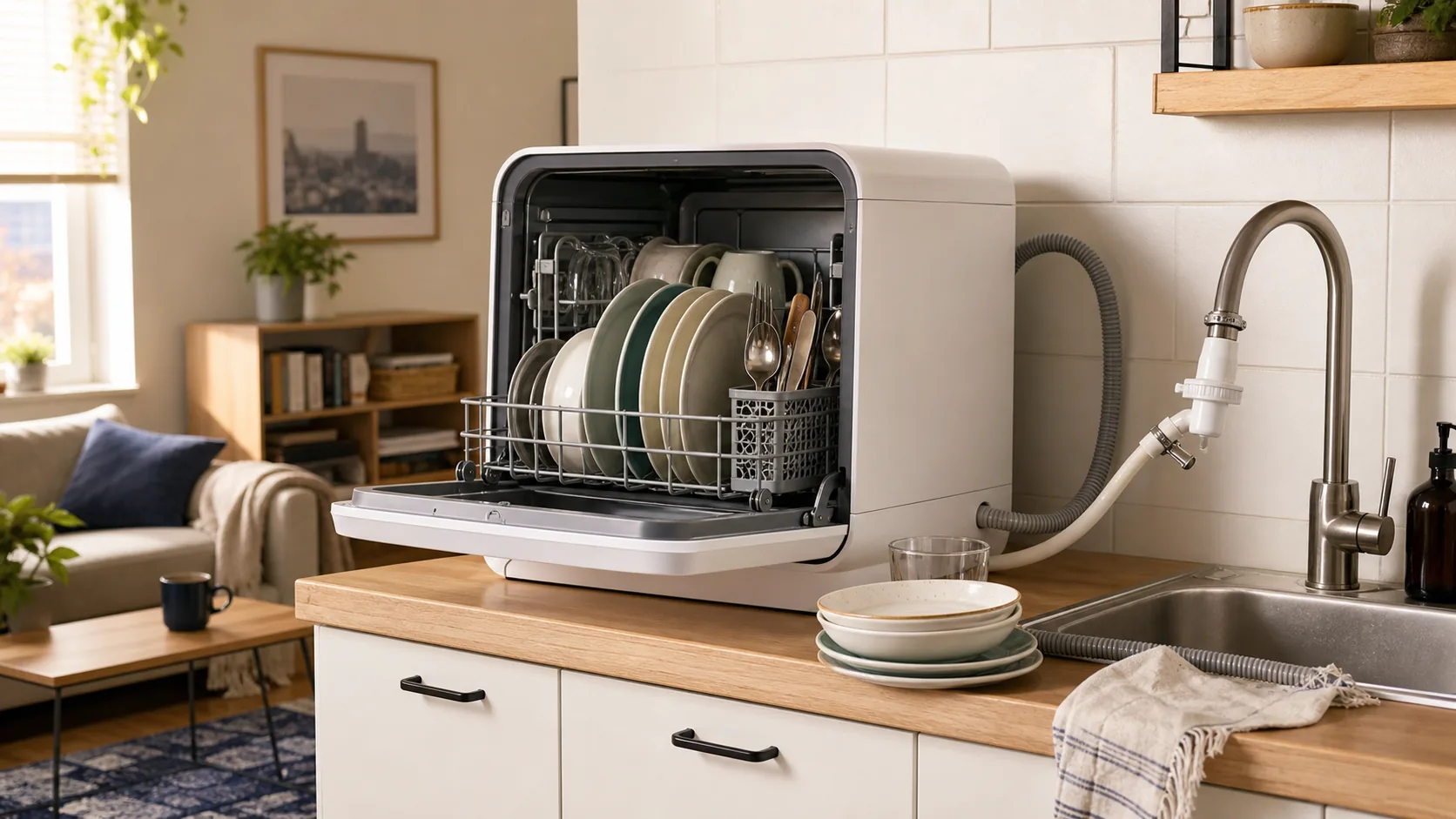
Start with the sink, not the appliance
A countertop dishwasher can be the right small-apartment upgrade, but only if the water path is boring. The machine needs a stable counter, a compatible faucet or fill tank, a drain route that will not slip, and enough clearance to open the door without blocking the kitchen.
This is why I would choose by setup first and capacity second. A six-place-setting model that cannot attach to your faucet is less useful than a smaller tank-fed machine that you can actually run twice a week.
Short answer
For most renters, the safest shortlist is a countertop dishwasher that can be installed without permanent plumbing changes, has a documented drain hose route, lists a realistic place-setting capacity, and has an energy/water label you can compare. Do not buy from a photo alone: measure the counter, faucet, cabinet clearance and plate diameter before checking out.
Skip the purchase if your lease forbids portable dishwashers, your counter cannot support the filled machine, or your sink area leaves the hose where it can flood the floor.
Three setup types to compare
| Type | Best fit | Main compromise |
|---|---|---|
| Faucet-connected countertop | Renters with a standard faucet and space beside the sink | Adapter compatibility and a hose across the sink area |
| Tank-fed countertop | Kitchens with pull-down faucets, unusual aerators or limited plumbing access | Manual filling and usually smaller loads |
| Portable rolling dishwasher | Larger rentals with floor space and full-size dish loads | Storage space, heavier movement and a bigger sink connection |
A built-in compact dishwasher is a different decision. It can be neater long term, but it is not renter-friendly unless the property owner approves the installation and any cabinet or plumbing work.
Capacity: place settings do not tell the whole story
Countertop dishwashers often advertise capacity in place settings. That helps compare models, but it does not guarantee your plates, pans or tall glasses will fit. Check the maximum plate diameter, rack height, cutlery basket position and whether the upper spray arm has clearance after loading.
A smaller machine can still be useful if your real pattern is bowls, mugs, plates and flatware. If your main pain point is cookware, sheet pans or mixing bowls, a countertop unit may reduce some daily dishes but will not replace hand washing.
Water and energy labels are not decoration
ENERGY STAR says certified residential dishwashers are evaluated for both energy and water performance. Use the label and official listing to compare similar-size machines instead of assuming that a compact unit is automatically efficient because it is small.
The most useful comparison is not just one cycle. Look at your expected weekly use: number of loads, cycle length, water fill method, heated-dry behavior and whether you will still hand-wash large items. A machine that runs small loads every day can use more total resources than a larger, better-filled load schedule.
Faucet compatibility is the common failure point
Before buying a faucet-connected model, inspect the faucet. Many portable dishwashers expect a removable aerator and an adapter. Pull-down sprayers, square designer faucets, hidden aerators and shallow sinks can complicate the connection.
Do not assume an adapter kit solves every faucet. Check the manufacturer manual for the supported connector style, and confirm whether the hose needs a specific water pressure range. If the faucet is shared with other people, also consider how annoying it will be to connect and disconnect the hose.
Drainage needs a physical plan
The drain hose should stay in the sink or approved drain without kinking or climbing in a way the manual does not allow. A loose hose can turn a small convenience purchase into a water-damage problem.
Tank-fed models still need a drain route. If the sink is far from the counter space, measure the hose path before purchase. If the only workable route crosses a walkway, the setup is probably wrong for that kitchen.
Noise, steam and heat in small kitchens
Countertop dishwashers are close to ears, work surfaces and living areas. Compare the published sound rating if available, but also think about when the machine will run. A 90-minute cycle during a work call is different from the same cycle after dinner.
Steam and warm air matter in a small apartment. Give the machine the clearance required by the manual, avoid trapping moisture under cabinets, and let dishes air-dry if heated dry makes the room uncomfortable.
What renters should verify first
- Lease language about portable appliances and water connections.
- Countertop depth, height clearance and weight support when the machine is filled.
- Faucet adapter compatibility or tank-fill access.
- Drain hose length and where the hose will sit during the cycle.
- Outlet location and whether the manual forbids extension cords.
- Door swing clearance and whether the rack can be pulled out safely.
- Noise tolerance in a studio or shared kitchen.
- Return window if faucet compatibility is uncertain.
Who should buy one
A countertop dishwasher makes the most sense for one or two people who cook regularly, have a sink-adjacent counter, and mostly want to remove plates, mugs and cutlery from the daily hand-wash pile. It is also a reasonable accessibility purchase when standing at the sink is the tiring part of cooking.
Who should skip it
Skip it if your kitchen has almost no counter space, your faucet cannot accept the connector, or the dishwasher would need to drain across a walkway. Also skip it if the main dishes you hate washing are large pans. A compact machine will not magically create full-size dishwasher space.
Pre-buy checklist
- Measure counter depth, cabinet clearance and door swing.
- Photograph the faucet and confirm the exact adapter requirement.
- Measure the largest plates you use weekly.
- Confirm whether the model has a tank, faucet hookup or both.
- Read the manual for drain-hose placement and electrical warnings.
- Compare ENERGY STAR listings or labels for similar-size models.
- Check filter cleaning and rinse-aid requirements.
- Confirm the seller return window before opening the box.
FAQ
Can a countertop dishwasher replace a full dishwasher?
Usually no. It can reduce daily hand washing, but it has less rack space and is less convenient for pans, serving bowls and tall items.
Is a tank-fed dishwasher better for renters?
It can be easier when the faucet is incompatible, but manual filling is another chore. The better choice depends on your sink layout and how often you will run loads.
Should I buy by the lowest water-use number?
No. Compare water and energy data with capacity and how full your typical load will be. A very small machine run half-empty every day may not be the practical winner.
Final verdict
A countertop dishwasher is worth considering when the kitchen layout supports it without improvisation. Buy the model that fits your faucet or tank routine, drains safely, holds your actual dishes and has comparable water/energy information. If any part of the water path feels like a workaround, keep looking.
Sources and methodology
- ENERGY STAR dishwasher guidance
- ENERGY STAR dishwasher key efficiency criteria
- ENERGY STAR certified residential dishwasher product finder
GameFunns did not test a dishwasher, install a faucet adapter or measure cycle noise for this guide. Product dimensions, adapter parts, prices and availability should be verified on the manufacturer or retailer page before purchase.