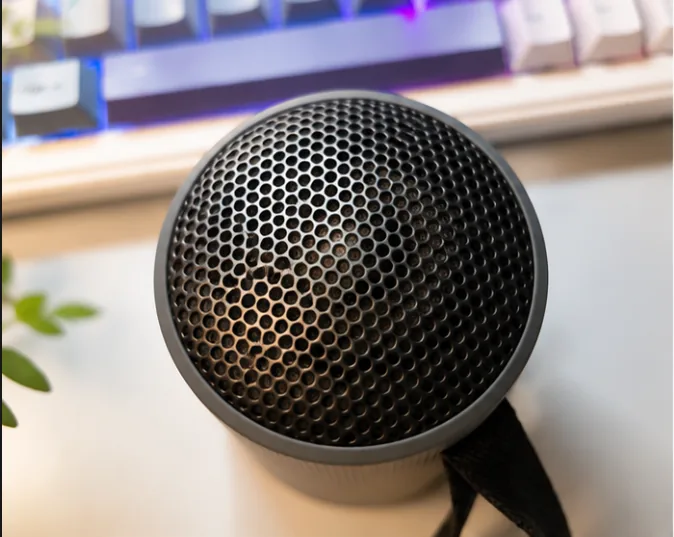
Short answer: choose the Sony SRS-XB100 if battery life and a bass-warm small speaker matter most. Choose the JBL GO 4 if app EQ, Auracast support, and a punchier feature set matter more than maximum claimed runtime.
The decision is not "which brand is better"
These two speakers solve the same broad problem: tiny Bluetooth sound that can survive casual outdoor use. The buying decision gets easier when you stop treating them as miniature hi-fi systems. At this size, you are choosing a compromise: longer claimed battery life, app control, linking features, shape, and tuning personality.
My SRS-XB100 ownership notes make Sony's appeal obvious. It is small, simple, durable enough for casual use, and easy to throw into a bag. The JBL GO 4, based on its official page, pushes harder on app control, Auracast multi-speaker linking, and a more colorful pocket-speaker identity.
Spec comparison
| Category | Sony SRS-XB100 | JBL GO 4 | What it means |
|---|---|---|---|
| Claimed battery | About 16 hours according to Sony | Up to 7 hours, plus 2 hours with Playtime Boost according to JBL | Sony is the calmer choice if charging less often matters. |
| Water and dust | IP67 according to Sony | IP67 according to JBL | Both fit casual outdoor and splash-prone use, with normal port-cover care. |
| Bluetooth | Bluetooth 5.3; SBC and AAC listed by Sony | Bluetooth 5.3 listed by JBL | Both are modern enough for basic phone pairing. |
| App features | Sony Music Center listed for FOTA only | JBL Portable app with EQ options and updates | JBL is stronger if you want app-based tuning. |
| Multi-speaker | Stereo Pair with compatible XB100 units | Auracast support for multiple compatible speakers | JBL looks more flexible for modern party-style linking. |
Why I would pick Sony
The SRS-XB100 is the better fit when the speaker will live in a bag, sit outdoors, or handle background listening away from a charger. Sony's official 16-hour battery claim is the main practical advantage. I have not run a controlled runtime test, but in ownership the speaker has not made battery anxiety part of the experience.
Sony also feels like the less demanding product. It does not ask you to think about EQ or app settings before casual listening. That simplicity is useful when the whole point is "small speaker I can just bring."
Why I would pick JBL
JBL is the more interesting option if you want app control and multi-speaker flexibility. The JBL Portable app lists EQ options, and the GO 4 supports Auracast according to JBL. If you like adjusting sound or already have newer JBL speakers, that ecosystem advantage may matter more than Sony's battery claim.
JBL also markets the GO 4 around punchier bass and a louder small-speaker personality. I cannot confirm that from my own listening, so I would treat it as a reason to compare in person if possible rather than as a guaranteed win.
Who should buy each one?
- Buy Sony SRS-XB100 if long claimed battery life, simple controls, and a warm bass-forward sound are the priorities.
- Buy JBL GO 4 if app EQ, Auracast, colors, and a more feature-heavy pocket speaker are more appealing.
- Skip both if you need room-filling volume, deep bass, stereo width from one unit, or measured hi-fi accuracy.
Final verdict
The Sony SRS-XB100 is the safer small outdoor speaker if you want fewer charging worries and an easy bass-warm sound. The JBL GO 4 is the more feature-rich pick if app control and modern multi-speaker linking are more important. For my use, Sony's endurance and simplicity are the stronger reasons. For a buyer who likes tuning sound and connecting speakers, JBL deserves the first look.